


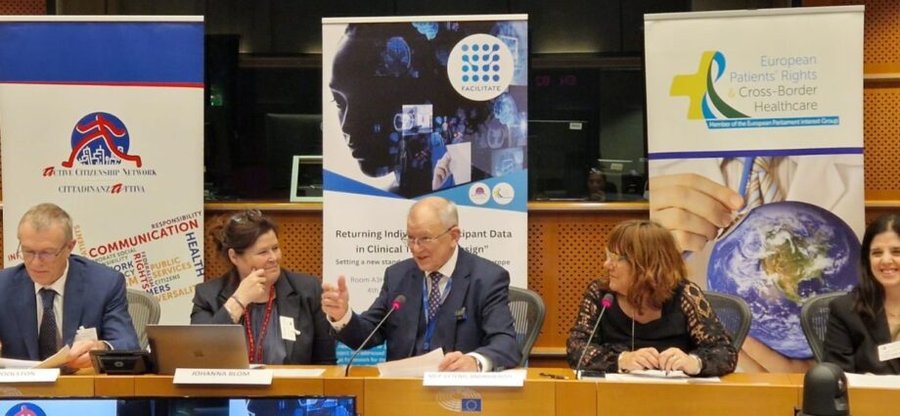
December 4, 2025, marks a milestone for patient rights in Europe. At the European Parliament in Brussels, the protagonists of the IHI FACILITATE (Framework for Clinical Trial Participants’ daTA) project reutilization for a full Transparent and Ethical Ecosystem presented the latest results of a four-year process aimed at radically transforming the relationship between citizens and clinical trials. The core of the challenge: ensuring that the return of individual data (Return of Individual Participant Data (RoIPD) is no longer a bureaucratic exception, but a principle foreseen from the design stage of the study.
Beyond GDPR: “By Design” Returns
Today, a clinical trial participant formally has the right to request their data, but the reality is very different. “It’s an extremely cumbersome process,” explains Professor Johanna Blom, coordinator of the FACILITATE project and professor at the University of Modena and Reggio Emilia (UNIMORE), “because it must be activated by the citizen who has to go knocking on the sponsor’s door. It’s complicated, it’s expensive, and it’s cumbersome for companies to find data from many years ago.”
The return of individual data to patients must be planned from the earliest stages of clinical trial design
FACILITATE proposes to flip this narrative. It shouldn’t be the patient who asks, but the trial sponsor, be it academic or industrial, who proactively offers access. “With this process, we’ve recognized that data return can’t be an afterthought, something we think about later,” Blom clarifies. “It must be incorporated by design into the trial protocol, defining from the outset what data to return, how, by whom and when.”
The “FACILITATE Principles”: from technicalities to everyday rights
The project’s ethical and legal complexity has been translated into concrete actions through the “FACILITATE Principles,” a simple language guideline led by Daniela Quaggia, Senior Project Manager for the Cittadinanzattiva-Active Citizenship Network (ACN). These principles, which have already been endorsed by 58 patient organizations and research centres, aim to bridge a profound emotional divide.
“The most striking gap we see is the shift from ‘study object’ to recognized partner,” Quaggia emphasizes. Many patients report that, once the study is concluded, contact and information disappear, taking with them the value of the human contribution made to science.
Knowing what data I will receive and who to contact if I have concerns reduces anxiety and strengthens trust in the system
The six operating principles include: advance planning, co-design with patients, equal access to information, and the use of clear language supported by a clinical point of contact. “Knowing what data I will receive and who to contact if I have concerns reduces anxiety and strengthens trust in the system,” the ACN manager reiterates.
What comes back to the patient: clinical utility and study integrity
However, not all data can be returned immediately. Blom distinguishes between primary objectives (such as survival or improved symptom management) and secondary data related for example to quality of life. “In areas such as neurodegenerative diseases such as Parkinson’s disease, knowing whether a drug is reducing daily functioning or pain is crucial for the patient,” explains the expert.
There is, however, an insurmountable limitation: for example in double-blind trials, returning data during the trial could invalidate the research. Furthermore, Blom urges caution with for instance exploratory biomarkers “These are experimental data that industry uses to identify future targets; returning them without clinical validation could generate confusion or unnecessary anxiety.”
Transparency against vaccine hesitancy
Data retrieval is crucial to reducing vaccine hesitancy. According to Quaggia, “seeing your data explained in the right context can be more convincing than any slogan.”
Personalized retrieval makes prevention “tailor-made”: citizens understand what the vaccine means for their specific protection, allowing them to make informed decisions together with their doctor.
Personalized data return makes transparency more concrete, understandable, and reassuring
This vision is supported by surveys of over 13,000 people: 80% of participants would like to receive their data, but almost none do.
Closing this gap is also of strategic value for the industry: “If you increase trust, you get higher recruitment rates and fewer trial interruptions,” Blom points out.
Europe as a beacon of data democracy
At a time when, as Blom notes, the political climate in the United States is leading to cuts in funding for diversity and equity in research, Europe is taking an ethical leadership role.
Next steps: The Paris Toolbox
Although the groundlaying phase has concluded, the Innovative Health Initiative (IHI) has granted an extension until June 30, 2026, to launch pilot studies.
Major companies such as Sanofi (Project Leader) and GSK are testing the model in clinical trials. From February 24 to 26, project leaders have met in Paris to develop a practical toolbox that will include forms and tools to sustain uptake of the return of individual data to clinical trial participants as part of the clinical research protocol.
“The genie is out of the bottle,” Blom concludes. “My hope is that individual data return becomes a standard of Good Clinical Practice.”
For Quaggia, data is just the beginning: to be equal partners, we need “tools, a voice, and operational safeguards” that transform research into a more humane and transparent “glass house.”