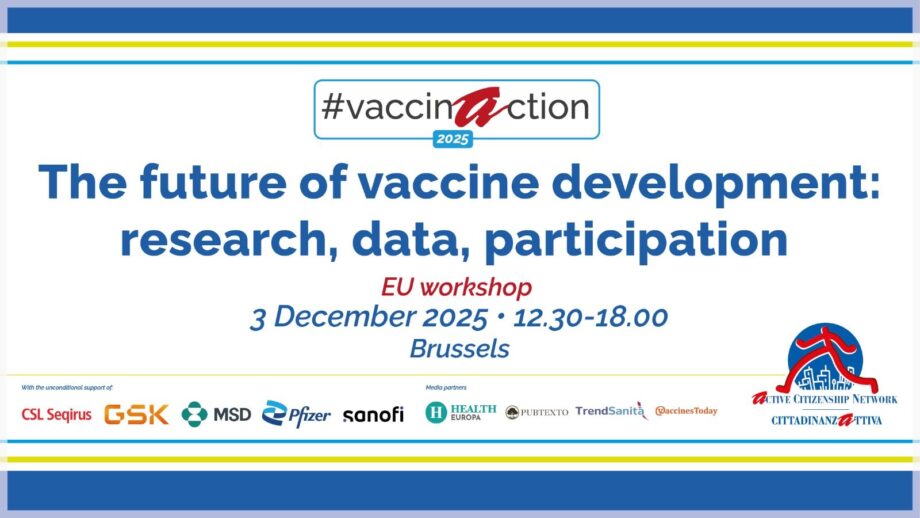


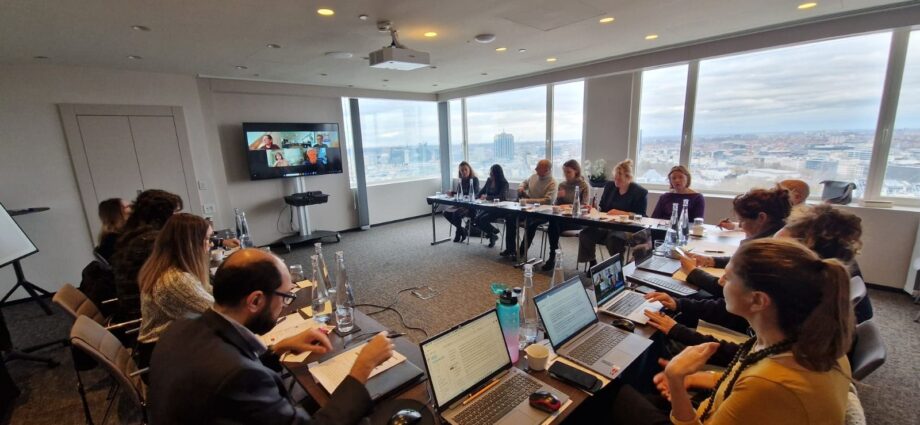
The world of infectious diseases is evolving rapidly: in the last 40 years, we have faced eight major threats and three pandemics. Against this backdrop, the European #VaccinAction 2025 workshop, “The future of vaccine development: research, data, participation” will focus on this issue . In Brussels, he outlined a clear vision: science can no longer simply chase emergencies; it must learn to prevent them. One of the keynote speakers at the debate was Dr. Rita Carsetti, Senior Advisor at the Fondazione Biotecnopolo di Siena and President of the International Union of Immunological Societies (IUIS). She was supported by the reflections of Cittadinanzattiva – Active Citizenship Network (ACN) , which had brought together 16 partner organizations from 12 countries for the occasion on the need to put citizens back at the center of immunization policies.
The rationale behind the “100 Days Mission”: saving eight million lives
The cornerstone of the new pandemic preparedness is the so-called “100 Days Mission,” a global goal supported by the G7, G20, and the World Health Organization. But why exactly 100 days? “It’s been calculated that in the early stages of a pandemic, not many people are infected; the exponential increase occurs after the first 100 days,” explains Carsetti.
It has been estimated that, during pandemics, the exponential increase in infections occurs after the first 100 days
Scientific rationale is supported by dramatic data: if we had developed a vaccine within 100 days of sequencing SARS-CoV-2, approximately eight million lives globally would have been saved. To achieve this goal, research is currently working on so-called “prototype pathogens.” This involves building already-tested and functional “base” vaccines, which simply require a change in the specific antigen, such as the Spike protein, to respond to a new threat, having already agreed on protocols and results with regulatory bodies in “peacetime.”
Reverse Vaccinology 3.0: AI as an Immunological Shortcut
The real technological leap forward is represented by Reverse Vaccinology 3.0, an approach that Carsetti calls a true shortcut. While version 2.0 began by analyzing survivors to isolate antibodies while already knowing the antigen, version 3.0 reverses the process thanks to AI.
“Today, we can take the memory cells of those who survived a new virus, even without knowing what the protective antigen is,” the immunologist explains. Through advanced models like AlphaFold 3, AI analyzes the structure of effective antibodies and “predicts” the shape of the molecular lock (the antigen) into which they should fit. This process reduces years of laboratory trials to a few targeted experiments, allowing us to design mRNA or recombinant protein vaccines in record time. This technology is already yielding promising results against global threats like Monkeypox.
The fight against the “silent pandemic” of AMR and bacterial linkage
The Siena Biotechnopole doesn’t just deal with viruses, but also addresses the crucial challenge of antibiotic resistance (AMR), defined as a “silent pandemic” that already causes five million deaths a year. Carsetti emphasizes that vaccines are the decisive weapon: “If you have a vaccine, you don’t need antibiotics because you won’t get the disease.”
Research has achieved extraordinary results against Shigella, a bacterium that kills thousands of children, with 100% protection in experimental models. The approach against pan-resistant Klebsiella pneumoniae is innovative, based on the “enchainment” mechanism : the selected antibodies do not simply bind to the bacterium, but “glue” it to its peers, preventing it from entering cells and causing sepsis. This method overcomes the limitations of older approaches, which often identified antibodies capable of binding to the target but incapable of neutralizing the disease.
Siena Biotechnopole: The Hub for European Independence
In this landscape, Italy plays a central role with the Biotecnopolo of Siena, a facility funded by the Italian government. The Biotecnopolo is also the coordinator of a European project designated as the European Vaccine Hub (EVH), which is supported by the European agency HERA and aims to ensure the continent’s autonomy in the development and production of vaccines for the prevention of future pandemics.
“Europe must be able to produce vaccines independently,” Carsetti reiterated. The EVH acts as an ecosystem that covers the entire cycle: from antigen discovery to the production of batches for Phase 1 and 2 clinical trials, ensuring that innovation doesn’t remain locked away in laboratories but becomes a public resource ready for emergency approval.
The human factor: transparency and active participation
Despite technological optimism, Dr. Carsetti warns that the greatest challenge remains environmental and social. “Personally, I believe climate change is the biggest problem,” she states in the interview, linking deforestation and the movement of species like bats to the emergence of new viruses.
Innovation must go hand in hand with patients’ rights
In this context, the #VaccinAction 2025 project, promoted by Active Citizenship Network (ACN), is crucial for sharing knowledge and rebuilding trust. Daniela Quaggia, Senior Project Manager for Cittadinanzattiva-Active Citizenship Network, emphasizes that innovation must go hand in hand with patient rights. “The greatest gap we see between research participants and organizers is the shift from ‘object of study’ to recognized partner,” explains Quaggia.
According to Cittadinanzattiva, data transparency is a powerful tool against vaccine hesitancy. “Seeing your immunological data explained in the right context can be more convincing than any slogan,” says Quaggia. Providing clear and understandable information isn’t just an act of courtesy, but a way to recognize the value of people’s role in science, transforming prevention into a conscious and tailored choice.
The “one hundred day race” can only be won if the speed of technology is combined with a culture of participation, where citizens are no longer passive observers but active stakeholders in global health security.